.
THE 2520 PROPHECY
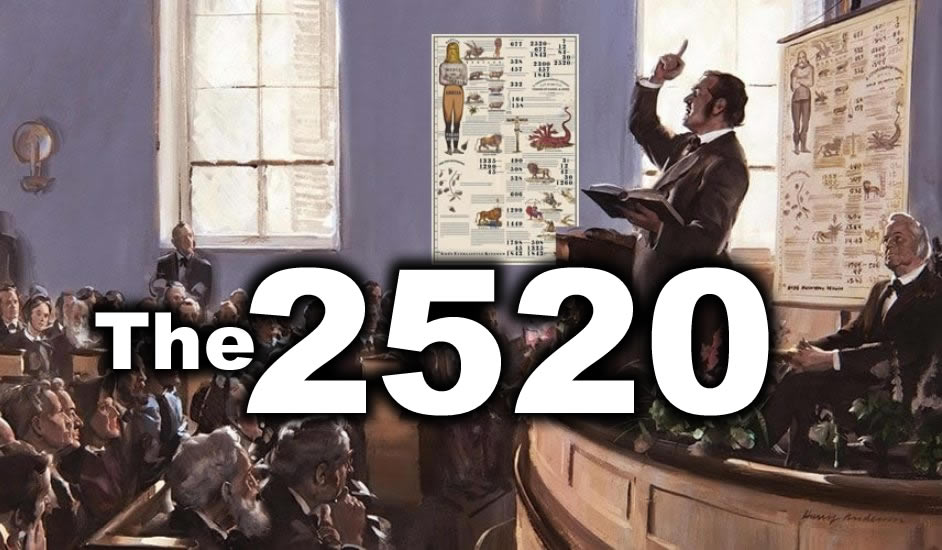 The 2520 prophecy, given by William Miller and other early advent pioneers, is based on the "seven times" of
Leviticus 26. They interpreted the 'seven times' of Leviticus 26 as a time prophecy in which the LORD would scatter His people due to their sins against Him. A 'time' equates to
360 prophetic 'days' (360 literal years), just like the 'time' of Daniel 7. Therefore, 'seven times' would equate to 2520 prophetic 'days' or 2520 literal years.
The 2520 prophecy, given by William Miller and other early advent pioneers, is based on the "seven times" of
Leviticus 26. They interpreted the 'seven times' of Leviticus 26 as a time prophecy in which the LORD would scatter His people due to their sins against Him. A 'time' equates to
360 prophetic 'days' (360 literal years), just like the 'time' of Daniel 7. Therefore, 'seven times' would equate to 2520 prophetic 'days' or 2520 literal years.
William Miller and the Millerites used the date 677 B.C. as the starting date for the 2520, when, due to the sins of Manasseh, he was captured and bound and the ten tribes were scattered and the 'pride of their power' was broken. Below I will share an excerpt from 'The True Midnight Cry' by Samuel Snow in 1844 regarding the 'seven times.'
"THE SEVEN TIMES OF THE GENTILES. The seven times of Gentile domination over the church of God, spoken of in Lev. x xvi., began with the breaking of the pride of their power. at the captivity of Manasseh, king of Judah, B. C. 677. See Isa. x. 5-12. Jer. xv. 3-9; Jet. 1. 17; 2 Chron. xxxiii. 9-11. This is the date assigned by all chronologers for that event. The seven prophetic times amount to 2520 years. As proof of this, see Rev, xii 6, 14, where 3 1-2 times are equivalent to 1260 years. A time therefore consists of 360 solar years, which multiplied by 7, make 2520. Had this period commenced with the first day of B. C. 677 it would have terminated with the first day of A. D. 1844, for 677 full years on one hand, and 1843 on the other, make 2520 complete years. It has been supposed that the period would end in A. D. 1843. But as a part of B. C. 677 is left out, a corresponding part of A. D. 1844 must be taken in to make the period complete. It must have been in autumn that Manasseh was taken captive. As proof of this, see Hosea v. 5; Isa. vii. 8; Isa. x. 11."
"Hosea declares that Ephraim and Israel shall fall, and that Judah also shall fall with them; Isaiah represents the king of Assyria as threatening to do to Jerusalem as he had done to Samaria; therefore the final carrying away of the ten tribes was before the invasion of Judah, and in the same year. The prophecy of Isa. vii. 8, is correctly dated B. C. 742; 65 years from that point bring us to B. C. 677. In that year was the final breaking of Ephraim, that it should not be a people. The history of this we find in 2 Kings, xvii. chapt. Kings did not go forth on their warlike expeditions in autumn or winter, but in spring or summer. Therefore in spring or summer of B. C. 677, Esarhaddon, and the Assyrians commenced removing the remnant of the ten tribes out of the cities of Samaria; and when they had accomplished this, they brought foreigners and placed them in their stead, to inhabit those cities. Having performed this work, which necessarily occupied some months, they were then ready to invade Judah. So that in the autumn of B. C. 677 they took the city of Jerusalem, and bound her king with fetters and carried him to Babylon. From that time 2520 years reach to the autumn of A. D. 1844. Then the times of the Gentiles will be fulfilled, the dispensation of the fullness of times will come, the Redeemer will come to Zion, and all Israel shall be saved." (S.S.Snow, The True Midnight Cry, Aug.22, 1844)
Then in 1856, the Advent Review and Sabbath Herald, a publication by our pioneers, published an article by Hiram Edson, showing that there was no event in 1844 which corresponded with the ending of the trampling down of God's people. Thus brother Edson showed that instead of using the date of the capture of Manasseh in 677 B.C. as the starting point, he showed that it was the capture of Hoshea, king of Israel in 723 B.C. that was the starting point of the 2520. I will now share an excerpt from the Hiram Edson article below:
"The event from which to reckon this period of indignation upon God's people, is the breaking of the pride of their power, the uprooting of their government and carrying them captives into their enemy's land foretold in Lev. xxvi, called in Dan. xii, the scattering of the power of the holy people."
"Ephraim in the prophecy of Isa. vii, 8, embraces the ten tribes which revolted from the house of David and chose their own line of kings which reigned over them in Samaria. These ten tribes were called Israel, and their kings, the kings of Israel, in distinction from the tribe and kings of Judah."
"In this prophecy of Isa. vii, 8, it is predicted that within (not at the close of-but WITHIN) three-score and five years Ephraim (not Judah) shall be broken that it be not a people. Manasseh was king of Judah, hence neither he, nor the tribe of Judah, are embraced in this prophecy ; and hence it is written, [2 Kings xviii,] when Ephraim or Israel was broken, and the Lord delivered Israel into the hand of spoilers and removed them out of his sight, there was none left, but the tribe of Judah, ONLY. And David also in Ps. lxxviii, speaks of the same event, where he gives an account of the sins of Israel which provoked the Lord so that he was wroth and greatly abhorred Israel, so that he forsook the tabernacle of Shiloh, the tent which he placed among men, and delivered his strength into CAPTIVITY, and his glory into the enemy's land. He gave his people over also unto the sword, and was wroth with his inheritance. Moreover he refused the tabernacle of Joseph, and chose not the tribe of EPHRAIM, but chose the tribe of JUDAH, the mount Zion which he loved."
"Thus we have the testimony of two witnesses which are said to be true, that the tribe of Judah was exempted from going into captivity at this point. And wherefore were they exempted? We answer, because it was written, [Gen. xlix, 10,] The sceptre shall not depart from Judah, nor a law-giver from between his feet until Shiloh come."
"From the above three important testimonies it is clear that the taking of Manasseh, king of Judah among the thorns, and binding him in fetters and carrying him to Babylon 677 B. C., cannot be the event nor point from which to reckon the seven times. Furthermore it is written that Manasseh humbled himself and was restored back and reigned over Judah in Jerusalem till the day of his death and was then succeeded by his son; and we have the account of a continued succession of the kings of Judah. Here perhaps the objector may quote Hosea v, 5. 'Therefore shall Israel and Ephraim fall in their iniquity: Judah also shall fall with them.' It is true that Judah has fallen with Israel and Ephraim; that is, they have since been scattered among the nations of the earth; but they did not fall at the same point of time, if their fall embraces their being broken from being a people, or nation. To fall with, may signify in like manner. That it does not always signify at the same point of time is evident. Paul has said, [1 Thess iv, 14,] Them also which sleep in Jesus will God bring with him; that is to say, they shall be brought from their sleep of death in like manner as Christ was raised, but not at the same point of time. This will appear still more clear by reading Isa. xxvi, 19. Thy dead men shall live, together with my dead body shall they arise. Awake and sing ye that dwell in the dust, &c."
"From the foregoing considerations we are unavoidably driven off from the taking of Manasseh king of Judah, bound to Babylon 677 B. C., as the point from which to reckon the seven times, and are necessarily compelled to take the breaking of Ephraim from being a people or nation from which to reckon the seven times or 2520 years captivity of the people of God. The record of which we find in 2 Kings xvii."
"In Isa. x, 5, 6, we read, 'O Assyrian, the rod of mine anger, the staff in their hand is mine indignation. I will send him against an hypocritical nation, and against the people of my wrath will I give him a charge to take the spoil, and to take the prey and to tread them down like the mire of the streets.' In 2 King xvii, we have the inspired record of the fulfillment of this prediction, which without further controversy is the point from which to reckon the appointed time of treading down the host like the mire of the streets."
"In verse 4 we learn that the king of Assyria took Hoshea king of Israel and shut him up and bound him in prison. Verses 5 and 6 read, 'Then the king of Assyria came up throughout all the land and went up to Samaria and besieged it three years. In the ninth year of Hoshea, the king of Assyria took Samaria, and carried Israel away into Assyria and placed them in Halah and in Habor by the river of Gozen, and in the cities of the Medea.'"
"Verse 24. 'And the king of Assyria brought men from Babylon, and from Cutha, and from Ava, and from Hamath, and from Sepharvaim, and placed them in the cities of Samaria instead of the children of Israel: and they possessed Samaria and dwelt in the cities thereof.' In verses 22, 23, it is written, 'For the children of Israel walked in all the sins of Jeroboam which he did; they departed not from them ; until the Lord removed Israel out of his sight AS he had said by ALL his servants the prophets. SO was Israel carried away out of their own land to Assyria unto this day.' Thus in 2 Kings xvii, is found the inspired record of the fulfillment of what God had said by his servant Isaiah, Chap x, 5, 6, and by Moses in Lev. xxvi, and by David in Ps. lxxviii, 59-62, and 1 Kings xiv, 15, 16. It is in fact the inspired historical record of the fulfillment of what God had said by ALL his servants the prophets on this point of giving Israel over into captivity to be trodden down of the Gentiles like the mire of the streets.' The validity of the above testimony cannot be invalidated or impeaced ; hence there can be no room left for further doubt on this so clear a point."
"This then is the inspired historical event; and its chronology, which is 723 B.C., is the point from which to reckon the 2520 years captivity. Instead of reckoning from the taking of Manasseh king of Judah to Babylon, 677 B. C., we reckon from the shutting up and binding in prison Hoshea king of Israel, which was 723 B. C. This was 19 years after Isaiah's prophecy, recorded in Chap. vii, 8, which was 742 b. c.; hence Ephraim was broken from being a people literally within three-score and five years. From whatever point in the year 723 B. C. we reckon, the same corresponding point in the year 1798, must be reached to fill up 2520 full years; the same as in the case of the 2300 days, dating from the Fall of 457 B. C., and ending in the Fall of 1844 A. D. The year 723 B. C. is the true beginning, and 1798 A. D. is the true terminus of the 2520 years captivity of the people of God. And we have a historical record of a corresponding event transpiring in the year 1798, which perfectly answers the fulfillment of the predictions of the prophets which have foretold the events which mark the end of the 2520 years indignation and captivity."
"It is a truth known and read of all men that in the year 1798 the Papal yoke was broken off, the dominion of the little horn, Papacy, [Dan. vii, 26] was taken away to consume and to destroy it unto the end ; and free toleration the heaven born boon of religious liberty has been the result. The saints are no longer under the Papal galling yoke. They are not under, but are free from, the dictation of the Papal see. God has been faithful to fulfill his word ; viz., 'I will deliver thee out of the hand of the (or that) wicked, I will redeem thee out of the hand of the terrible.' Jer. xv, 21." (Hiram Edson, Advent Review and Sabbath Herald, January 10, 1856 p.113-114)
So now we have two 2520 timelines. And while some people find difficulty in believing in either of these timelines, they both find very interesting fulfillment in their end dates. What would God do after the scattering of His people is accomplished due to sin? He would then gather His people again. And the two timelines above given by the pioneers fulfill both the scattering and gathering of God's people. Not just literal Jews of the flesh, but ALL of God's true people - true Israel, whether Jew or Gentile in Christ, as we are all one in Christ. And so the 2520 from 723 B.C. to 1798 A.D. fulfils the scattering when Papal Rome is crushed in 1798 and God's people are no longer under the yoke of it's enemies. And the 2520 from 677 B.C. to 1844 A.D. fulfils the gathering when God begins to gather His people once more in truth and love, to go in to the wedding with Christ and be ready for His return.
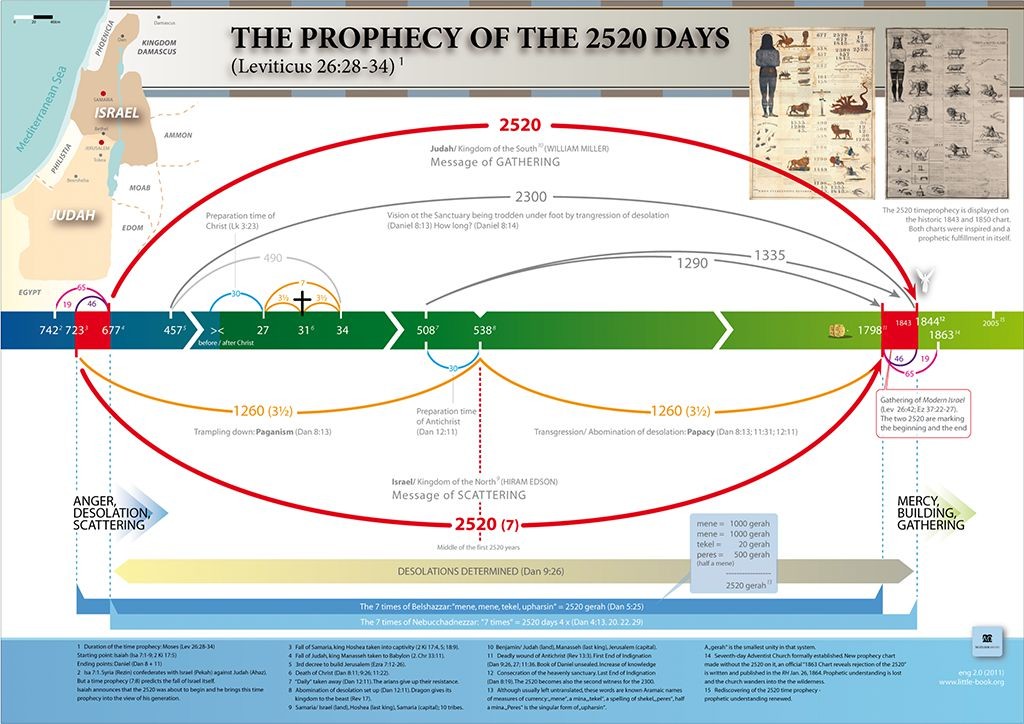 Even though this teaching ended up being rejected later on by other pioneers of the Advent movement, due to them believing that the 'seven times' of Leviticus 26
was not a time prophecy, but simply a prophecy of severity of punishment, you will see from the chart (click on the image),
that there is an interesting fulfillment of this timeline. The 2520 was included on the original pioneer 1843 and 1850 charts, and it gives even more support to
the 1798 and 1844 dates, which the 2300, 1260, 1290 and 1335 prophecies of Daniel point to. For more on those, please see the following studies.
Even though this teaching ended up being rejected later on by other pioneers of the Advent movement, due to them believing that the 'seven times' of Leviticus 26
was not a time prophecy, but simply a prophecy of severity of punishment, you will see from the chart (click on the image),
that there is an interesting fulfillment of this timeline. The 2520 was included on the original pioneer 1843 and 1850 charts, and it gives even more support to
the 1798 and 1844 dates, which the 2300, 1260, 1290 and 1335 prophecies of Daniel point to. For more on those, please see the following studies.